Clinical Note Accuracy: Context-Aware Intelligence
Dr. Dhruv Patel
Clinical Content Lead
Share

A standard clinical consultation rarely exists in a vacuum. Most patients arrive with a history: prior diagnoses, recent laboratory results, imaging reports, and letters from other specialists.
Yet, generic AI medical scribes only know what is spoken aloud during the current session. If you don't explicitly restate the patient's entire medical history during the check-up, the AI-generated note will be incomplete.
To solve this, IntuScribe is built with Context-Aware Clinical Intelligence. By integrating complete patient context directly into the note synthesis process, IntuScribe ensures that your medical records aren't just transcripts of what was spoken—they are clinically informed, highly accurate records grounded in the patient’s complete medical reality.
The Limitation of Transcript-Only Scribes
Generic ambient recorders listen to the room and summarize what they hear. While this works for simple acute visits (like a cold or simple sprain), it falls short for complex chronic care:
- Hallucination Risk: When the AI lacks historical context, it might misinterpret ambiguous verbal cues, leading to errors.
- Omission of Prior Conditions: If you adjust a patient's thyroid medication during a consult but don't restate their history of Hashimoto's thyroiditis, the AI cannot include the underlying diagnosis in the note.
- Disconnected Plans: The AI cannot align today's management plan with past treatment notes without continuity.
How Context-Aware Clinical Intelligence Works
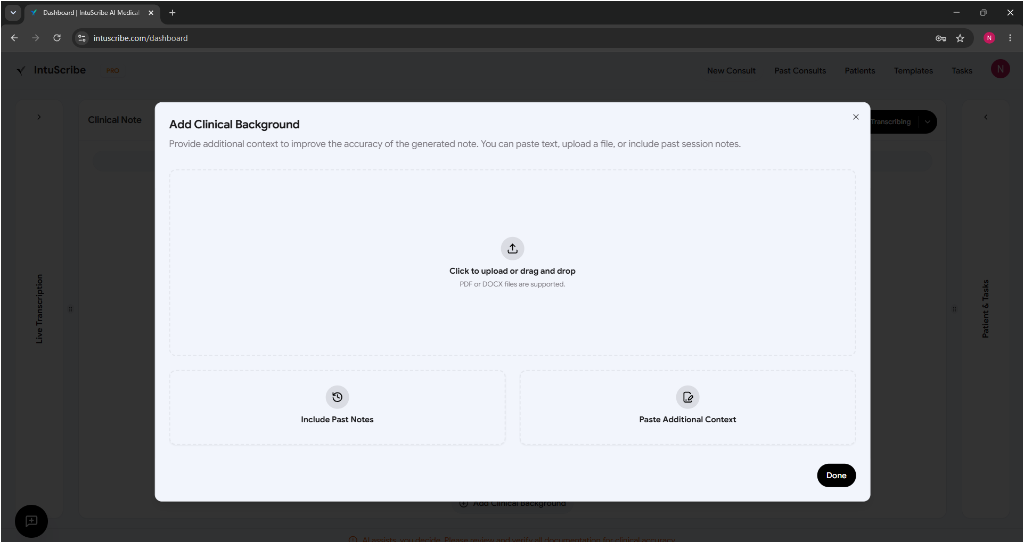
IntuScribe automatically merges active consultation speech with critical patient history. In the IntuScribe workspace, the Clinical Intelligence Layer (CIL) builds a unified clinical context using four core feeds:
1. Automatic Permanent Record Integration
When a patient is selected in the workspace, their permanent records—such as verified drug allergies, clinical contraindications, or treatment restrictions—are automatically loaded into the active session. This ensures the Clinical Intelligence Layer is immediately aware of high-risk medical alerts and never documents contraindicated medications or ignores critical patient sensitivities in the final plan.
2. File and Document Uploads
Upload patient-specific documents, such as PDF pathology results, DOCX imaging reports, or referral letters. IntuScribe securely parses the text from these files, allowing the CIL to reference and synthesize complex diagnostic data without you needing to read it aloud.
3. Past Session Note Linking
Select and link past treatment notes from previous visits recorded in IntuScribe. The AI analyzes these notes to maintain continuity in active treatment plans, progress tracking, and clinical reviews.
4. Custom Pasted Context
Directly paste any last-minute clinical notes, pre-existing conditions, active medication updates, or personal diagnostic intent to guide the AI's logical reasoning before the recording begins.
The Omission Rule: Protecting Data Integrity
To guarantee absolute accuracy, our CIL follows a strict, clinician-designed Omission Rule. The AI is programmed to only include information that is explicitly documented in either the spoken transcript or the background context materials.
If a section in your selected template requires data that was neither discussed nor included in your background documents, the AI will omit that line entirely. It will never invent facts, guess numbers, or insert placeholder text.
Chronic Care Management: The Context Challenge
Consider a typical consultation in chronic disease management—for instance, managing a long-term patient with Type 2 Diabetes, microvascular complications, a severe penicillin allergy, and a recent HbA1c of 8.4%.
During a brief 15-minute consultation, the clinician and patient might only verbally discuss adjusting the insulin dosage and treating a mild skin abrasion. Under a traditional transcript-only AI scribe, the generated note would simply state: "Patient has diabetes. Plan: Adjust insulin. Prescribed antibiotic for abrasion." This note completely omits the patient's microvascular history and risks documenting a penicillin-class antibiotic because the allergy wasn't verbally restated during the check-up.
With Context-Aware Clinical Intelligence, this documentation gap and clinical risk are resolved:
- Automatic Permanent Alerts: The patient's penicillin allergy is automatically pulled from their permanent record and loaded into the session.
- Supplemental Background Data: The clinician uploads the recent pathology lab report showing the 8.4% HbA1c and links the previous endocrinology consult.
- The Consultation: The doctor conducts the check-up normally, focusing entirely on the active symptoms, insulin adjustment, and dressing the abrasion.
- Contextual Output: The Clinical Intelligence Layer synthesizes a rich, accurate note that respects all contraindications: "Patient with history of Type 2 Diabetes, microvascular complications, and elevated HbA1c (8.4%). Penicillin allergy noted. Plan: Adjust insulin... prescribed non-penicillin antibiotic..."
Conclusion: Cultivating Context for Safer Care
Clinical documentation requires context to be safe and effective. By weaving spoken words together with historical documentation, IntuScribe ensures that your progress notes are clinically grounded, compliant, and highly accurate.
Elevate your documentation accuracy. Start your 4-week free trial of IntuScribe today.
About the Author
Dr. Dhruv Patel, MBBS, FRANZCR, EBIR
Dr. Dhruv Patel is a Consultant Radiologist and Specialist in Interventional Radiology, holding Australian (FRANZCR) and European (EBIR) qualifications. With over a decade of clinical experience across major Australian hospitals, he has first-hand experience with the administrative burden that pulls clinicians away from patient care. To solve this, Dr. Patel co-founded IntuScribe in Brisbane, combining clinical insights with generative AI to build a sovereign, medical-grade Clinical Intelligence Layer that seamlessly fits the active workflows of GPs and Allied Health professionals.
Note from the Medical Lead
"I built IntuScribe because I was tired of finishing notes at 9 PM. If you're a clinician in Australia looking for a smarter way to manage your clinical workflow, I invite you to try our Clinical Twin (Beta) assistant."